

Firstly, let me explain about what happened with the Khmer Rouge in the 70s and 80s in Cambodia. As you may know, there was a revolution in our country – anybody who was suspected of being an intellectual was killed – even people who wore glasses were put to death. The Khmer Rouge wanted to make us something akin to an agricultural utopia with rights for all. But this utopia included the torture and murder of more than 1.5 - 2.2 million of my fellow countrymen, which represented about 15% to 30% of the population at this time.
This affected my parents and grandparents. Although this occurred before I was born, my elders had to abandon everything they had in Svay Rieng Province (located next to the southern Vietnamese border) and walk diagonally right across the country to Battambang Province. They were forced to do this by the Khmer Rouge. You dared not argue with them! If you look at Google Maps, it will tell you that it is a 91-hour walk on the highway, but for my elders, it was much longer because they had to walk through the jungle scavenging for food along the way – the Khmer Rouge were not willing or able to transport them nor supply food. People were dying of starvation, sickness, malnutrition, hopelessness and just plain tiredness all along the way. Nowadays, by car, it takes 7 hours or so and is a distance of about 700km’s.
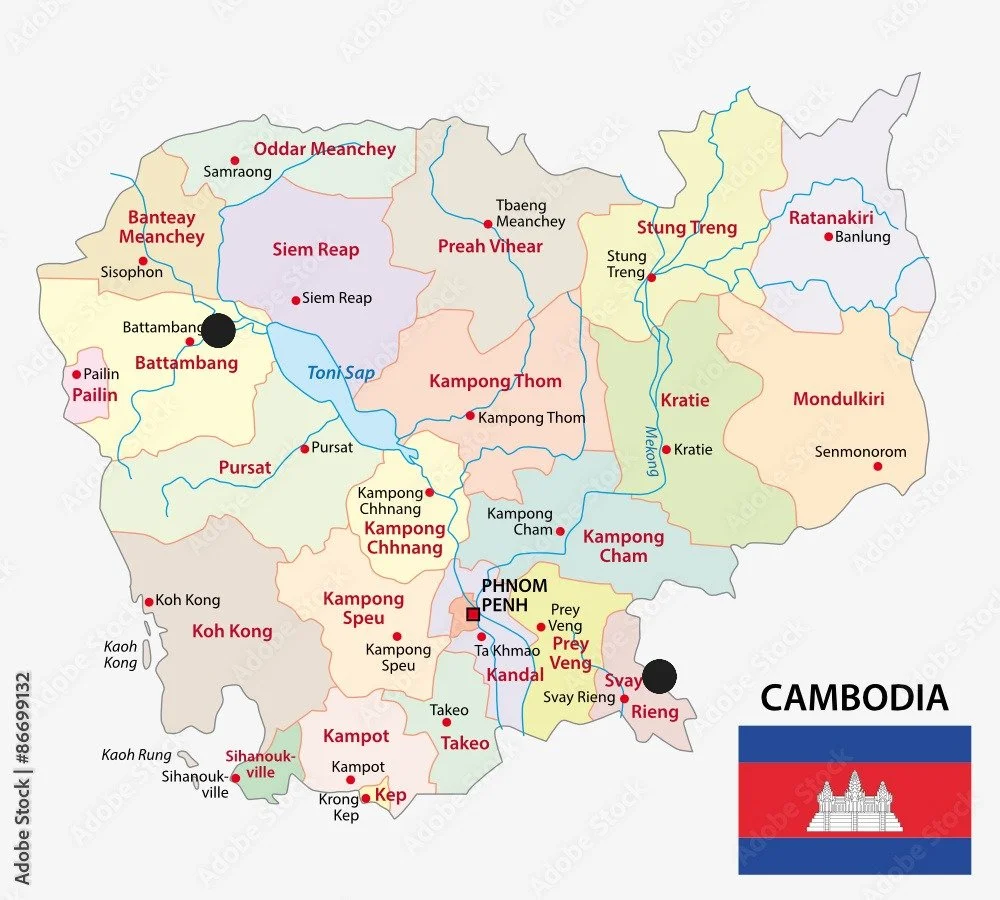
My mom told me that halfway along the journey, one night the Khmer Rouge simply abandoned them. They, and all of the others, were all left alone. Well, everybody just kept walking to Battambang Province anyway. But when they arrived in Battambang, there was nothing there for them. So my parents just turned around and walked back towards their village again. When they arrived in Phnom Penh, they thought, “Well, we could stay here, and we could just take any one of the abandoned houses.” This is because there was virtually nobody living in the city. However, there were Khmer Rouge soldiers there who would take their food if they could even find food! Securing food was very difficult because it was a city, and there were very few gardens or fruit trees, so they kept on walking. In retrospect, it probably would have been good to have taken over a number of houses in the city there, possibly belonging to dead or displaced people, because now they would be millionaires. But at the time, they simply had to survive, so they kept on walking back towards their home village in Svay Rieng Province. When they arrived in Kandel Province, the village headman was very kind to them and gave them some land that they could permanently use to cultivate rice and vegetables. So, they settled there and never made it back to the home village.
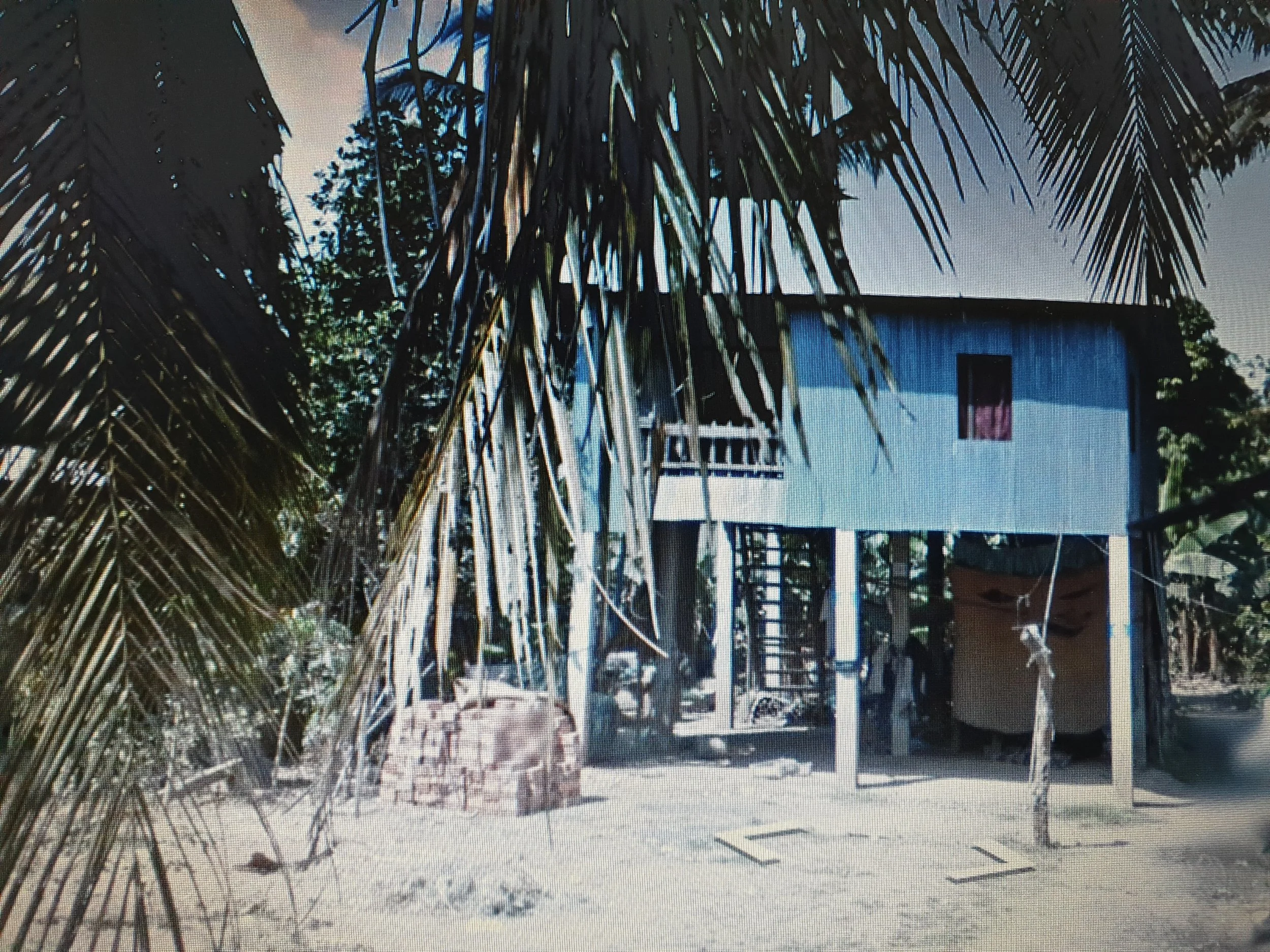
I came along in 1988. I was a village boy - you can see my house below. I was just 10 years old when I gave up my schooling. I was illiterate. One day, I got taken to the village pagoda, where for six months a Buddhist monk taught me how to read and write. I got pretty good. Then I returned to formal grade school again. When I did exams, my old teacher thought that I was cheating because I could do a three-hour exam in just one and a half hours. For my geography exam, he stood next to me for the whole exam just to see if I was cheating. I am so grateful to the monk for helping me. I have tried to find him to thank him, but I suspect that he has died.
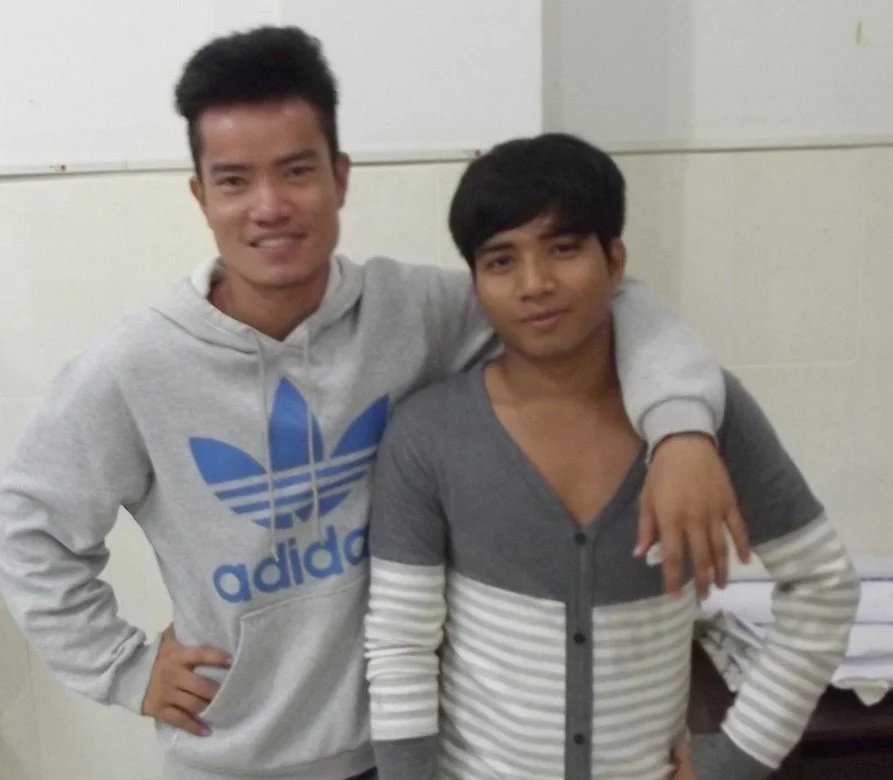
Kong Sovan (left), who is now a medical doctor and my brother, Borey.
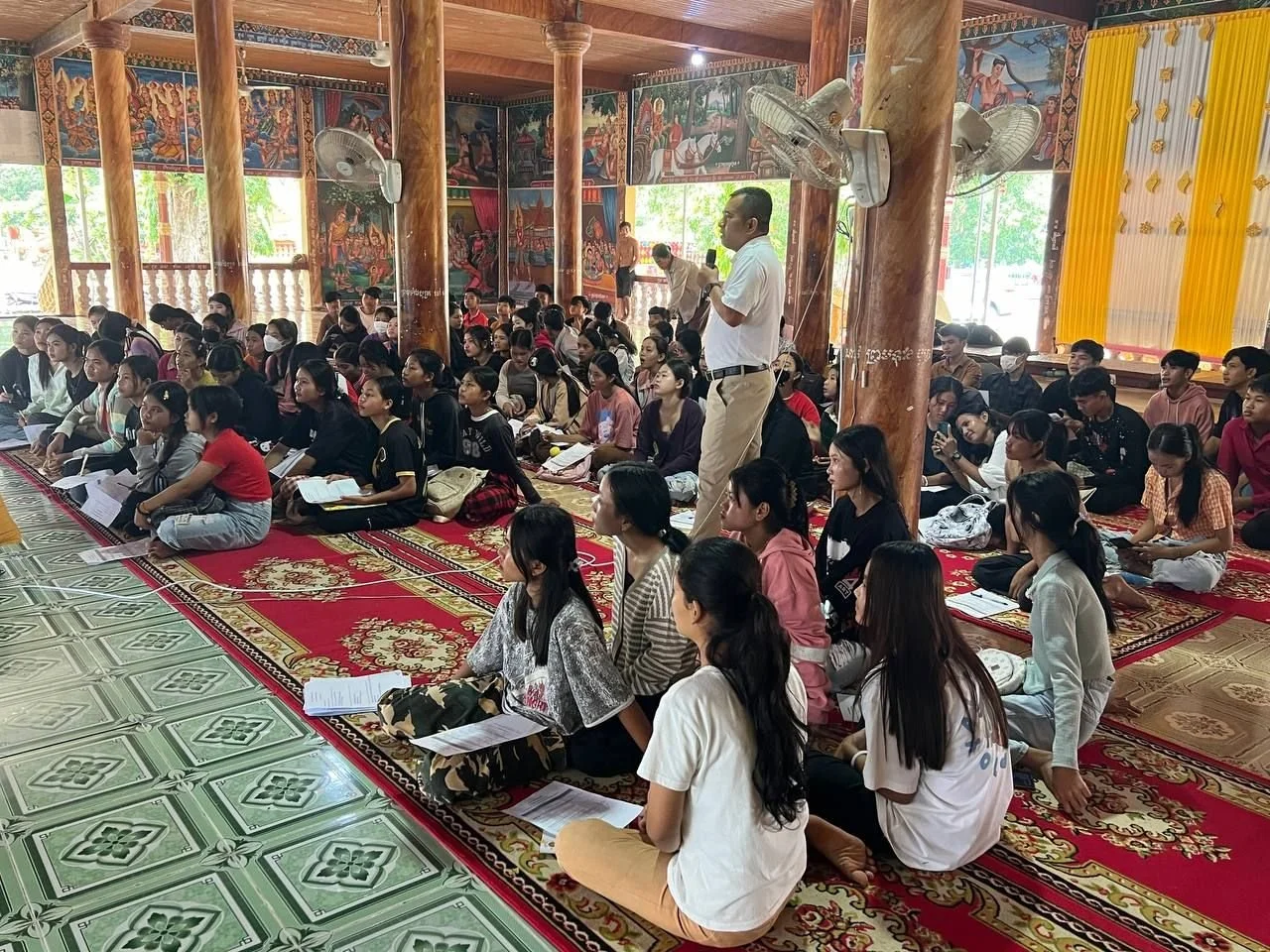
This is the thing about my dad, up until his death in 2000, he was a friendly guy who used to give fish and vegetables to people. One of the people with whom he was generous with was a man named Prak. He was a schoolteacher, but also, he was a pastor of a church. Mr Prak said to my dad that he knew of a place in Phnom Penh that looked after boys and educated them. Mr Prak asked me if I would like to go along there and receive an education. The first time that he asked, I just ignored it and did not go. Then there was a second invitation, and I finally jumped into the car at the very last minute. This was my last chance to go there. When I arrived in Phnom Penh, I was quite bewildered, and of course, I missed my family. But the boys and the house parents there were very friendly. In Phnom Penh, you could see people who were living on the street, drug addicts, and there were gangs, so I had to be careful because it was nothing like living in my village. Each night, we boys would have to be in the house by 5:00 PM with the outside gates locked because of the insecurity in the city. You have to remember that this was not long after the end of the Khmer Rouge time and the invasion by Vietnam. There were some kids at the house who wanted to go home because they missed their village, but for me, I wanted to get an education. At the house, I was quite a popular boy because each night at bedtime, the boys would sit around my bed in the dark while I told them ghost stories.
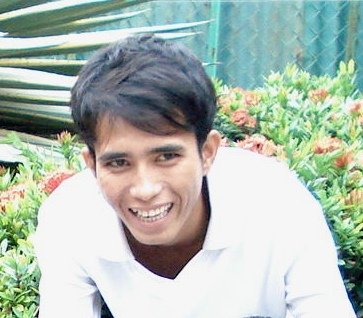
At the house, we had plenty of food, books, pens, etc. We never had these things on a regular basis back in the village. Also, we had the opportunity to study in extra classes and to receive tuition and opportunities for computing and English. The best thing about living at the house was that our house parents made us all feel like we were living in one big happy family. We had so much time to study and have fun, whereas back in the village, if I even went to school, when I returned home, I would have to look after the cows or work on the farm. Our house parents would counsel us and help us in our education in any way that they could. I am so grateful to them for their kindness.
Joshua House was a Christian home, although I did not really know what that meant because I had grown up in a Buddhist context. When I first arrived at the home, I was 16 years of age and within about one year, I became a Christian believer. I did not do this to try and make the house parents happy or so that I could keep getting food, but I just thought it was a good decision.
When I would return to my village during the school holidays, I was the only Christian person there, except for a few families that were Seventh Day Adventists. Village people said that I was following a foreign religion - there was always this heavy belief that if you were Cambodian, then you were Buddhist.
My dad worked ploughing rice fields with his tractor. There were six of us kids at the time. I was the second oldest. In about 2000, when I was about 13 years old, my dad died. This was a big shock to us. Compounding our now precarious economic situation, my oldest brother accidentally fell out of a tree, damaging his back and internal organs. The village people said that this bad luck was because our ancestors were punishing him for some reason that I could never understand. But this was the way that rural ancestor worship – spirit worship – Buddhist people thought. Later on, after I became a Christian, I told my mom that what the people were saying was not true. This had an influence on her also becoming a Christian - in fact, all of my family have become Christians because of the time that I spent at Joshua House. Now, back to my injured brother, because he was so sick from his fall, he spent three years in the local hospital. My mom stayed in the hospital with him the whole time, and so we, the other four kids and I were looked after by my grandparents and our uncle. We were now financially devastated; in fact, we had to sell our land to pay for his hospital fees. This was a particularly painful experience because my mum went to one of our relatives to request financial help to look after my four siblings and I, along with my sick brother. My older relative would not help but instead said that Mum should just sell our land to pay for his costs. So, she did. But she sold it to him at a low price – we felt powerless and manipulated by our own family members. We felt so hurt by this, but what else could we do? I decided that as a family we should not bear a grudge; instead, we would forgive, even though our relative has never asked for forgiveness. Yes, we have forgiven him, but to this day, we cannot forget what he did to us. Jesus taught us to forgive and to be kind to people, regardless of whether they deserve it or not. And so that is what we chose to do. Besides, Jesus has been kind to me when I have not deserved it. Sadly, some time later, my older brother died.
Meanwhile, my younger brother also went to the pagoda to learn how to read and write. I was able to get him to come to Joshua House. Now he has a Bachelor of Engineering.
Every night, our Joshua House parents, Mr Sao and Mrs Chantha, would sit with us to read the Bible and pray with us. We would have to remember key Bible verses. If we forgot them, then we had fun because they would “punish us” by making us run around the outside of the house five times. Sometimes I would get angry at myself for not remembering and run an extra five laps. After a while, I started reading the Bible for myself. This was all so different to my previous life, where we would talk to spirits and try to keep them happy. For example, if my Buddhist friends and I were walking into a forested area, we would ask the spirits for permission to enter and ask them not to hurt us. We would put ourselves under their sovereignty. But with Jesus, we did not have to do this kind of thing anymore.
When I completed high school, I was able to study for a Bachelor of Law at the Royal University of Law and Economics. I never thought that this could be possible. How could an illiterate village boy both attend and then graduate from university? I thought that at best I might finish high school, but more likely give up on school prematurely and end up working as a farmer or at a building site somewhere. Simply moving to the city was beyond my expectations. As soon as I completed my fourth and final year of study, and before I got my results, I was given a scholarship to study the Bahasa Indonesian language at the University of Surabaya, Indonesia for a year. My life perspective grew now because I experienced other cultures and other types of thinking.
When I returned to Phnom Penh from Indonesia, I got a job working as a Khmai language teacher to foreigners. This was definitely not what I had in mind when I studied law. My disappointment grew when that job finished and I was then being paid to be a caregiver to a little boy. I pleaded with God to rescue me from this so that I could practise law.
Chap Dai is a Christian organisation that rescues women from illegal employment situations and exploitation. Sometimes, we were working with women and children who had been used in prostitution. Chap Dai was advertising for a position for a case manager to work in the area of anti sex trafficking. This sounded like my type of thing, so I applied. I sat the English exam and passed, then a week or so later I was interviewed, where they asked a number of questions that I could not answer! Later, they called me back and said, “Congratulations Vibol, you have the job!” I was so happy because now I could use my law degree to help exploited people. I was there for five years, making legal cases against those who had exploited people. I worked with many government departments, including the Departments of Labour and Women’s Affairs, as well as various embassies in Cambodia and overseas.
Later, I worked for a five-year period with International Justice Mission (IJM) in Phnom Penh. My task was to work with a Cambodian specialist police investigation team. My role was to bring cases against those suspected of employment exploitation. After two years, I moved to Government Relations, where I worked with the national counter trafficking department. I spent a lot of time both travelling overseas and working with provincial governors, teaching and partnering with them to work against exploitation. Running meetings with senior government and provincial leaders was not easy, but the opportunity to rescue those who have been exploited made up for it.
Recently, I passed The Bar exam, and now I am working as a self-employed lawyer. I still love to take on cases where vulnerable people have been cheated or used. I like to do these cases pro bono if I can.
Another joy in my life is that EMPOWER Cambodia had been struggling for quite some time, so some of my EMPOWER graduate brothers and I, along with other folks, have transformed the ministry over the last few years. I am the board chair of the ministry.
Here in Cambodia, we call our ministry Smart Youth Cambodia, but you may continue to refer to it as EMPOWER Cambodia. We use a lot of modern NGO-thinking that my brothers and I have gained over the years. It is exciting to see our young people now not only attending university, but also graduating and then going back to their hometowns as Christian workers.
And can you believe this? This boy from the rice fields, who was illiterate even though he attended school, is now married to a judge. Now we have a new baby boy. Can you see what God can do in our lives? My life has been completely transformed.